Home Equity Line of Credit

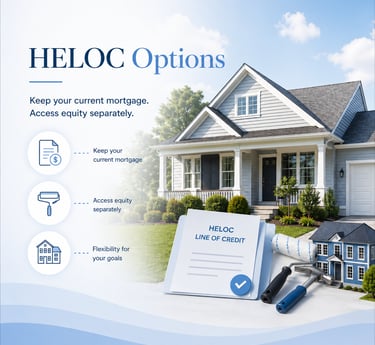
A HELOC may allow you to access home equity while keeping your current first mortgage in place. This can be useful for renovations, repairs, debt payoff, investment property needs, or flexible access to funds — especially if your current mortgage has a lower interest rate you do not want to replace.
Access Home Equity Without Replacing Your Current Mortgage
A Home Equity Line of Credit, commonly called a HELOC, allows homeowners and qualified property owners to access available equity through a revolving line of credit. Instead of refinancing your entire first mortgage, a HELOC is typically added as a separate loan secured by the property.
This can be a strong option if you want to use home equity but do not want to give up your current mortgage rate.
A HELOC may be used for:
Home renovations
Repairs or improvements
Debt consolidation
Emergency reserves
Education expenses
Investment property expenses
Rental property improvements
Flexible access to funds over time
HELOC Highlights
HELOC options may include:
Fixed-rate or adjustable-rate options
Access to funds as needed
Ability to keep your current first mortgage
Flexible draw options
Interest may only be charged on funds used
Potential option for renovation financing based on after-renovation value
HELOC options for primary residences
HELOC options for investment properties
Useful alternative to a cash-out refinance
Helpful when your current mortgage has a lower interest rate
Why Homeowners Use a HELOC
Many homeowners have built up equity but do not want to refinance their current mortgage.
That is especially true if they already have a low first-mortgage rate.
A HELOC may help you access equity while leaving your current mortgage alone. This can be useful when a cash-out refinance would force you to replace your entire current mortgage with a new loan at today’s rate.
For some homeowners, keeping the existing first mortgage and adding a HELOC can be a better structure.
Keeping Your Current Low Mortgage Rate
This is one of the key reasons homeowners consider a HELOC.
If your current first mortgage has a lower interest rate than current market rates, a cash-out refinance may not be attractive because it replaces your entire mortgage.
A HELOC may allow you to:
Keep your current first mortgage
Avoid refinancing the full loan balance
Access only the equity you need
Use funds for renovations or other goals
Preserve your existing mortgage structure
This does not automatically mean a HELOC is better than a cash-out refinance. It means both options should be compared based on your mortgage, equity, rate, payment, costs, and goals.
Fixed-Rate and Adjustable-Rate HELOC Options
HELOCs may be available with different rate structures depending on the lender and program.
Adjustable-rate HELOCs may have a rate that changes over time based on the loan terms and market conditions. Adjustable-rate HELOCs can provide flexibility, but the payment may change if the rate changes.
Fixed-rate HELOC options or fixed-rate draw options may provide more payment predictability compared with a fully adjustable option.
The right structure depends on how much equity you need, how quickly you plan to use the funds, how long you expect to carry the balance, and your comfort level with payment changes.
HELOC for Renovations
A HELOC can be a strong option for homeowners who want to renovate but do not want to refinance their existing first mortgage.
This may be helpful if you want to:
Remodel a kitchen
Update bathrooms
Finish a basement
Build an addition
Replace major systems
Improve the home before selling
Increase property value
Make the home more functional for your family
Instead of replacing your current mortgage, a renovation HELOC may allow you to access funds separately while keeping your existing mortgage in place.
Renovation HELOC Based on ARV
One of the more flexible options we can review is a renovation HELOC based on after-renovation value, also known as ARV.
This means the lender may evaluate the home’s projected value after the improvements are completed, not just the current value of the property.
That can matter because some homeowners do not have enough current equity to fund the full renovation, but the planned improvements may increase the home’s value.
A renovation HELOC based on ARV may help homeowners:
Access renovation funds without refinancing the first mortgage
Keep a current low-rate mortgage in place
Borrow based on the projected improved value
Complete larger renovation projects
Avoid using high-interest credit cards or personal loans for improvements
Improve the home while maintaining a better overall mortgage structure
This option is subject to credit approval, project review, property eligibility, valuation review, contractor documentation, equity requirements, and lender guidelines.
HELOCs for Investment Properties
We may also be able to provide HELOC options on investment properties.
This can be useful for real estate investors who have equity in a rental property but do not want to refinance the existing first mortgage. Many investors have low-rate first mortgages on rental properties, and replacing that loan with a new cash-out refinance may not always make sense.
An investment property HELOC may help investors:
Access equity from a rental property
Keep the existing first mortgage in place
Fund repairs or renovations
Improve rental property condition
Cover property-related expenses
Prepare a property for a tenant
Fund improvements before selling or refinancing
Access capital without disrupting the current loan structure
Investment property HELOC guidelines may be more restrictive than primary residence HELOC guidelines. Credit score, equity, property type, rental property cash flow, reserves, occupancy, and lender requirements can all affect eligibility.
Why Investors May Use a HELOC
Real estate investors often want access to capital without disturbing existing financing.
An investment property HELOC may be worth reviewing when an investor wants to:
Keep a low-rate rental property mortgage
Avoid a full cash-out refinance
Access funds for property improvements
Maintain flexibility for future repairs or projects
Use equity without selling the property
Improve cash flow planning for rental properties
This can be especially useful when the current first mortgage has favorable terms that the investor does not want to lose.
HELOC vs Cash-Out Refinance
A HELOC is usually a separate loan or line of credit added behind your current first mortgage.
A cash-out refinance replaces your existing mortgage with a new larger mortgage.
The difference is simple:
HELOC: keep your current mortgage and add a line of credit.
Cash-out refinance: replace your current mortgage and access cash through the new loan.
A HELOC may be better when:
Your current mortgage rate is low
You do not want to refinance your full first mortgage
You want flexible access to funds
You only need to draw funds as needed
You are funding renovations in stages
You own an investment property with a strong existing mortgage
A cash-out refinance may be better when:
You want one mortgage payment
You need a larger lump sum
The new first mortgage terms are attractive
You want fixed-rate long-term financing
You are consolidating multiple debts into one payment
You want to restructure the entire mortgage
The right option depends on your current mortgage, equity, loan amount, interest rates, renovation plans, property type, occupancy, and long-term goals.
HELOC vs Home Equity Loan
A HELOC is typically a revolving line of credit. You may be able to draw funds as needed during the draw period, subject to loan terms.
A home equity loan is usually a lump-sum second mortgage with a fixed repayment schedule.
A HELOC may be better if you want flexibility.
A home equity loan may be better if you know the exact amount you need and want a more predictable payment structure.
Common Uses for a HELOC
Homeowners and property owners may use a HELOC for:
Renovations
Home repairs
Kitchen remodels
Bathroom updates
Basement finishing
Additions
Debt consolidation
Emergency reserves
Education costs
Large planned expenses
Rental property repairs
Investment property improvements
Real estate investment needs
The best use is usually when the HELOC supports a clear financial goal and fits your repayment plan.
How Much Can I Borrow With a HELOC?
The amount you may be able to borrow depends on:
Home value
Current mortgage balance
Available equity
Credit profile
Income and debts
Property type
Occupancy
Loan program
Lender guidelines
Whether the property is a primary residence or investment property
Whether the HELOC is based on current value or after-renovation value
For renovation HELOC options based on ARV, the lender may also review:
Project scope
Estimated renovation cost
Contractor details
After-renovation value estimate
Property condition
Improvement plan
For investment property HELOCs, the lender may also review:
Rental property status
Lease income or market rent
Investment property equity
Investor reserves
Property cash flow
Overall borrower credit and financial profile
Our HELOC Review Process
We compare your current mortgage, equity, property type, and goals before recommending a HELOC.
Our review may include:
Current first mortgage balance
Current mortgage interest rate
Estimated property value
Available equity
Desired HELOC amount
Credit profile
Income and debt review
Occupancy type
Primary residence vs investment property
Fixed vs adjustable-rate options
Renovation plans, if applicable
ARV-based options, if applicable
Cash-out refinance comparison, if useful
The goal is not simply to open a line of credit. The goal is to determine whether a HELOC is the right structure for what you are trying to accomplish.
When a HELOC May Make Sense
A HELOC may make sense if:
You have available equity
You want to keep your current mortgage
Your first mortgage rate is lower than current rates
You want flexible access to funds
You are planning renovations
You want to draw funds over time
You need a second-lien option instead of a full refinance
An ARV-based renovation HELOC helps fund improvements
You own an investment property and do not want to refinance the first mortgage
When a HELOC May Not Be the Right Fit
A HELOC may not be the right option if:
You do not have enough equity
The payment is not affordable
You are uncomfortable with adjustable-rate risk
You need long-term fixed financing
You want one single mortgage payment
A cash-out refinance provides a better overall result
You do not have a clear repayment plan
The renovation scope does not fit lender guidelines
The investment property does not meet lender requirements
A HELOC is flexible, but flexibility can become a problem if the line is used without a plan.
VA IRRRL Refinance FAQs
What is a VA IRRRL?
A VA IRRRL is a VA Interest Rate Reduction Refinance Loan. It is used to refinance an existing VA-backed loan, often to lower the interest rate, reduce the monthly payment, or move from an adjustable-rate mortgage to a fixed-rate mortgage.
Do I need to already have a VA loan?
Yes. A VA IRRRL is designed to refinance an existing VA-backed home loan.
Can I take cash out with a VA IRRRL?
No. A VA IRRRL is not a cash-out refinance. If you want to access home equity, a VA cash-out refinance or another refinance option would need to be reviewed.
Does a VA IRRRL require an appraisal?
A VA IRRRL may not require a new appraisal in many cases, depending on lender requirements and the file structure. Guidelines can vary, so this should be confirmed during the loan review.
Does a VA IRRRL require income verification?
A VA IRRRL may involve reduced documentation compared with a standard refinance. Whether income verification is required depends on the lender, file structure, and applicable guidelines.
Does a VA IRRRL have a funding fee?
A VA funding fee may apply unless the borrower is exempt. The VA states that borrowers may need to pay the funding fee, along with lender interest and closing fees.
Can the VA funding fee be rolled into the loan?
Often, yes, depending on the scenario and program guidelines. This should be reviewed during the loan estimate and refinance comparison.
Is a VA IRRRL always worth it?
No. A VA IRRRL should be reviewed based on rate, payment, closing costs, funding fee, recoupment period, loan term, and how long you expect to keep the loan.
Can I refinance from a VA ARM to a fixed-rate mortgage?
Yes. One common reason to use a VA IRRRL is to move from a VA adjustable-rate mortgage into a fixed-rate mortgage for more payment stability.
How do I know if a VA IRRRL makes sense?
The best way is to compare your current VA loan against the new VA IRRRL option, including rate, payment, closing costs, funding fee, recoupment period, and long-term loan structure.
Contact
Armstrong Mortgage LLC – NMLS #2444347 Equal Housing Opportunity
Phone - Call or Text
michael@armstrongmtg.com
463-218-7843
317-362-6346
© 2025. All rights reserved.
Michael Armstrong – NMLS #1623098
Important Disclosures
Program guidelines, rates, terms, and availability are subject to change without notice. All loans are subject to credit approval, underwriting review, property eligibility, collateral review, title review, and applicable program guidelines. Stated guidelines are not a commitment to lend. Meeting minimum credit score, down payment, reserve, acreage, and loan amount requirements does not guarantee approval. Rates are subject to market conditions and borrower qualifications. Call for current rate information based on your specific loan scenario. Additional restrictions may apply.