FHA Streamline Refinance
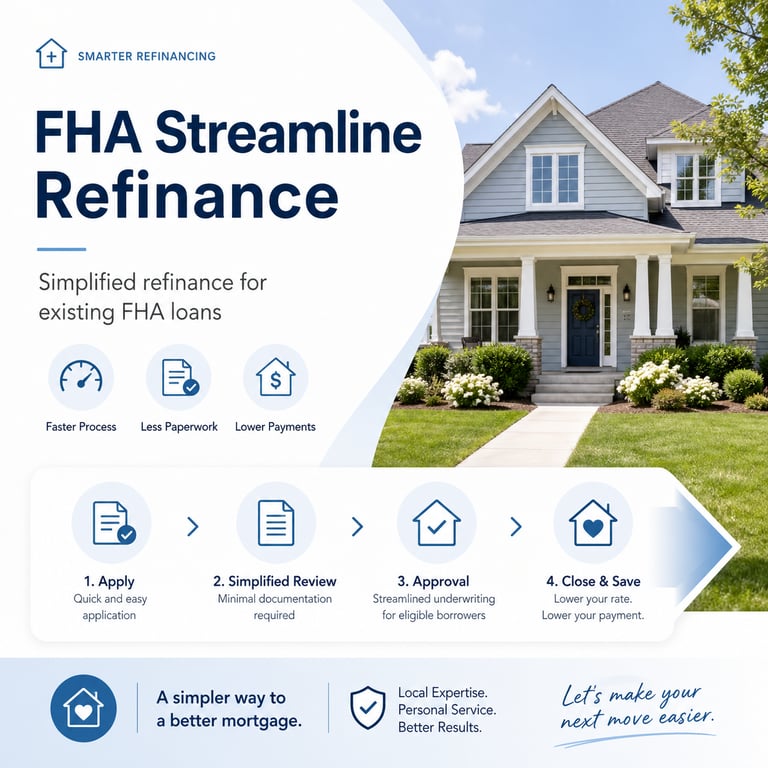
An FHA Streamline Refinance may help eligible homeowners with an existing FHA loan lower their payment, improve their rate, or move into a better loan structure with reduced documentation. We can review your FHA Streamline options with a soft credit pull only, meaning no hard credit inquiry is needed to start.
A Simplified Refinance Option for Existing FHA Borrowers
An FHA Streamline Refinance is designed for homeowners who already have an FHA-insured mortgage and want a simpler way to refinance. Compared with a standard refinance, an FHA Streamline may require less documentation and may not require a new appraisal in many cases.
This refinance option may help eligible FHA borrowers lower their monthly payment, improve their interest rate, reduce mortgage insurance costs in some scenarios, or move from an adjustable-rate mortgage into a fixed-rate mortgage.
HUD explains that FHA Streamline Refinances are available under credit qualifying and non-credit qualifying options, and that “streamline” refers to the reduced amount of documentation and underwriting required — not that the loan has no costs.
FHA Streamline Refinance Highlights
Designed for homeowners with an existing FHA loan
Reduced documentation compared with many standard refinances
No cash-out refinance option
Cash back is generally limited
Net tangible benefit required
May not require a new appraisal in many cases
May not require full income documentation in certain scenarios
Can be reviewed with a soft credit pull only
No hard credit pull needed to start the review
What Is an FHA Streamline Refinance?
An FHA Streamline Refinance is a refinance program for borrowers who already have an FHA mortgage.
The purpose is usually to improve the borrower’s loan terms without going through the same level of documentation required for a standard refinance.
An FHA Streamline Refinance may help borrowers:
Lower their monthly mortgage payment
Reduce their interest rate
Move from an FHA adjustable-rate mortgage to a fixed-rate mortgage
Improve the overall loan structure
Refinance without a full traditional refinance process
The existing loan being refinanced must already be FHA-insured, must be current, and the new refinance must provide a net tangible benefit to the borrower.
Soft Credit Pull Only — No Hard Credit Pull Needed to Start
One of the biggest advantages of our FHA Streamline review process is that we can review options with a soft credit pull only.
That means we can evaluate your FHA Streamline Refinance scenario without starting with a hard credit inquiry.
This may be helpful if you want to:
Check whether refinancing may make sense
Review possible payment savings
Avoid a hard credit pull upfront
Compare your current FHA loan against a new FHA Streamline option
See whether there is a net tangible benefit before moving forward
This is a strong feature for borrowers who want to explore refinance options without immediately impacting their credit report with a hard inquiry.
No Cash-Out With an FHA Streamline Refinance
An FHA Streamline Refinance is not designed to pull equity out of the home.
If your goal is to access cash from your home equity, you would need to review a different refinance option, such as a cash-out refinance.
For FHA Streamline Refinances, HUD states that cash in excess of $500 may not be taken out through the streamline process.
The main purpose is to improve the loan terms, not to access equity.
Net Tangible Benefit Requirement
An FHA Streamline Refinance must provide a net tangible benefit to the borrower.
In plain English, the refinance needs to create a real benefit. That benefit may include a lower payment, a better loan structure, or moving from an adjustable-rate mortgage into a fixed-rate mortgage, depending on the scenario.
This requirement helps prevent borrowers from refinancing unless there is a meaningful reason to do so.
We review your current FHA loan and compare it against the proposed FHA Streamline option to determine whether the refinance meets the benefit requirement and makes sense for your situation.
Reduced Documentation
An FHA Streamline Refinance may involve less documentation than a standard refinance.
Depending on the scenario and whether the file is credit qualifying or non-credit qualifying, the process may involve reduced documentation related to income, assets, appraisal, and credit review.
This can make the process simpler for eligible borrowers who already have an FHA loan and are current on their mortgage.
HUD describes streamline refinances as requiring limited borrower credit documentation and underwriting compared with a standard refinance.
FHA Streamline Credit Qualifying vs Non-Credit Qualifying
FHA Streamline Refinances may be structured as either credit qualifying or non-credit qualifying.
A non-credit qualifying FHA Streamline may require less documentation and may not require the same level of income and credit review as a standard refinance.
A credit qualifying FHA Streamline may be required in certain scenarios, such as when removing a borrower from the loan or when additional credit review is needed.
The FDIC’s mortgage lending guide describes FHA Streamline Refinances as having credit qualifying and non-credit qualifying versions. It notes that the credit qualifying version involves income and credit documentation, while the non-credit qualifying version does not involve a credit check.
For your website, I would keep this section simple. Borrowers do not need to become guideline experts. They need to understand that the file type depends on their scenario.
No New Appraisal in Many Cases
An FHA Streamline Refinance may not require a new appraisal in many cases.
This can be helpful if:
Your home value has not increased much
You are unsure of your current appraised value
You want a simpler refinance process
You want to avoid the extra time and cost of an appraisal
This does not mean every FHA Streamline file avoids all property review. It means a full new appraisal may not be required in many FHA Streamline scenarios.
Who May Benefit From an FHA Streamline Refinance?
An FHA Streamline Refinance may be a good fit for homeowners who:
Already have an FHA loan
Are current on their mortgage
Want to lower their monthly payment
Want to reduce their interest rate
Want to move from an FHA ARM to a fixed-rate mortgage
Want a simpler refinance process
Want to review refinance options with no hard credit pull upfront
Do not need cash out from their home equity
When an FHA Streamline May Not Be the Right Fit
An FHA Streamline Refinance may not be the right option if:
You do not currently have an FHA loan
You want to take cash out of your home equity
The refinance does not create a net tangible benefit
Your current FHA loan is not current
A conventional refinance would remove mortgage insurance and create a better result
Closing costs outweigh the benefit
You plan to sell the home soon
This is why we compare your current FHA loan against available refinance options before recommending a structure.
FHA Streamline vs Conventional Refinance
An FHA Streamline Refinance may be simpler if you already have an FHA loan.
However, a conventional refinance may sometimes be better if:
You have enough equity to remove mortgage insurance
Your credit profile has improved
You qualify for better conventional pricing
You want to refinance out of FHA mortgage insurance
The long-term savings are stronger with a conventional loan
The right answer depends on your current loan, home value, credit profile, mortgage insurance, closing costs, and long-term goals.
We can compare both options if it makes sense.
FHA Streamline Refinance FAQs
What is an FHA Streamline Refinance?
An FHA Streamline Refinance is a simplified refinance option for homeowners who already have an FHA-insured mortgage and want to improve their loan terms with reduced documentation.
Do I need an existing FHA loan to use an FHA Streamline Refinance?
Yes. The mortgage being refinanced must already be FHA-insured.
Can you review my FHA Streamline option with a soft credit pull?
Yes. We can review your FHA Streamline Refinance options with a soft credit pull only, so no hard credit pull is needed to start the review.
Does an FHA Streamline require a hard credit pull?
Not always for our initial review. We can start with a soft credit pull only. Whether additional credit documentation is needed depends on the specific file, lender, and whether the streamline is credit qualifying or non-credit qualifying.
Can I take cash out with an FHA Streamline Refinance?
No. An FHA Streamline is not a cash-out refinance. Cash back is generally limited, and HUD states that cash in excess of $500 may not be taken out through the streamline refinance process.
Does an FHA Streamline require an appraisal?
Many FHA Streamline Refinances may not require a new appraisal, depending on the scenario and program requirements.
What is the net tangible benefit requirement?
The refinance must provide a real benefit to the borrower, such as a lower payment, improved loan structure, or moving from an adjustable-rate mortgage to a fixed-rate mortgage.
Is income documentation required?
Not always. FHA Streamline Refinances may be credit qualifying or non-credit qualifying. Documentation requirements depend on the scenario and lender guidelines.
Is an FHA Streamline always better than a conventional refinance?
No. Sometimes a conventional refinance may be better, especially if you have enough equity to remove mortgage insurance. We can compare both options.
How do I know if an FHA Streamline makes sense?
The best way is to compare your current FHA loan against the proposed refinance, including payment, rate, mortgage insurance, closing costs, loan amount, and long-term benefit.
Contact
Armstrong Mortgage LLC – NMLS #2444347 Equal Housing Opportunity
Phone - Call or Text
michael@armstrongmtg.com
463-218-7843
317-362-6346
© 2025. All rights reserved.
Michael Armstrong – NMLS #1623098

Important Disclosures
Program guidelines, rates, terms, and availability are subject to change without notice. All loans are subject to credit approval, underwriting review, property eligibility, collateral review, title review, and applicable program guidelines. Stated guidelines are not a commitment to lend. Meeting minimum credit score, down payment, reserve, acreage, and loan amount requirements does not guarantee approval. Rates are subject to market conditions and borrower qualifications. Call for current rate information based on your specific loan scenario. Additional restrictions may apply.