Cash-Out Refinance
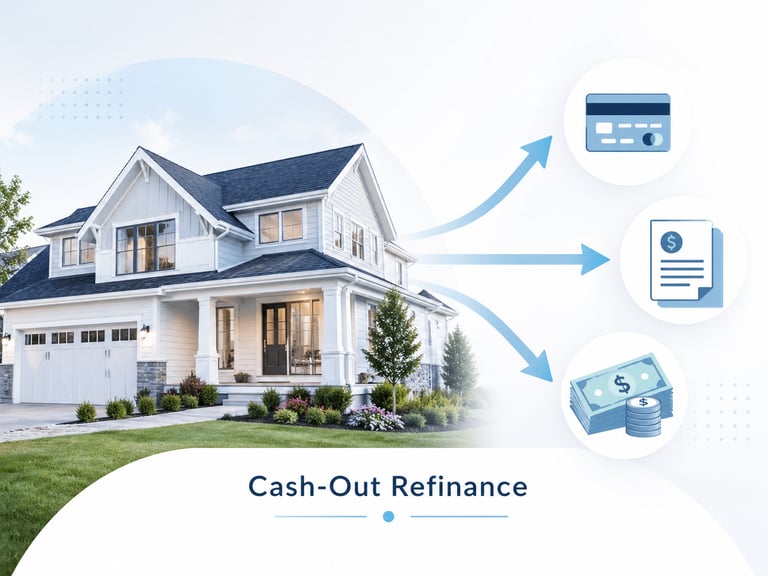
Use your home equity to access cash, consolidate higher-interest debt, complete home improvements, or improve your overall financial structure. We can compare traditional cash-out refinance options and specialty programs that may allow qualified borrowers to access more equity than many standard lenders allow.
Use Home Equity to Access Cash
A cash-out refinance allows you to replace your current mortgage with a new loan for more than you currently owe and receive the difference in cash. Homeowners often use a cash-out refinance to consolidate debt, complete home improvements, pay off high-interest loans, or create more financial flexibility.
A cash-out refinance is not just about getting cash. It needs to be reviewed carefully to determine whether the new loan structure actually improves your financial position.
We help homeowners compare cash-out refinance options based on:
Current home value
Current mortgage balance
Available home equity
Credit profile
New loan amount
Interest rate
Monthly payment
Closing costs
Debt payoff strategy
Long-term financial impact
Cash-Out Refinance Highlights
A cash-out refinance may help you:
Access equity from your home
Pay off higher-interest credit cards
Consolidate personal loans
Pay off installment debt
Fund home improvements
Create reserves or liquidity
Potentially improve monthly cash flow
Replace multiple debts with one mortgage payment
Review options up to 90% loan-to-value, if eligible
Explore cash-out options with no PMI, subject to program guidelines
Up to 90% LTV Cash-Out Refinance Options
Most lenders commonly limit cash-out refinances to around 80% loan-to-value, depending on the loan program and borrower qualifications.
That means if your home is worth $500,000, many standard cash-out refinance options may only allow total financing up to approximately $400,000.
However, we have access to a lender option that may allow qualified borrowers to complete a cash-out refinance up to 90% loan-to-value with no PMI.
That can be a major difference for homeowners who have equity but need access to more of it.
This may help borrowers who want to:
Pay off higher-interest debt
Consolidate credit cards or personal loans
Complete home improvements
Improve cash flow
Access more equity than standard cash-out programs allow
Avoid adding private mortgage insurance
This program is subject to credit approval, property eligibility, underwriting review, loan amount, occupancy, equity, and full program guidelines.
Why 90% LTV With No PMI Matters
The difference between 80% LTV and 90% LTV can be significant.
For example, on a $500,000 home value:
80% LTV: $400,000 maximum loan amount
90% LTV: $450,000 maximum loan amount
That could mean access to an additional $50,000 in potential equity, depending on your current mortgage balance and qualifying scenario.
The no PMI feature matters because many higher-LTV mortgage options require mortgage insurance. A cash-out option up to 90% LTV with no PMI may help qualified borrowers access more equity without adding a separate monthly mortgage insurance payment.
This is not available for every borrower or every scenario, but it can be powerful when it fits.
Using Home Equity to Pay Off Higher-Interest Debt
One of the most common reasons homeowners consider a cash-out refinance is to pay off higher-interest debt.
This may include:
Credit cards
Personal loans
Auto loans
Installment loans
Medical debt
Private loans
Other higher-interest obligations
Mortgage rates are often lower than many credit card or unsecured debt interest rates. If the numbers work, using home equity to consolidate debt may reduce monthly payments, simplify finances, and potentially lower the blended interest rate across your debts.
But this needs to be handled carefully.
You are moving unsecured or shorter-term debt into a mortgage secured by your home. That can help in the right situation, but it is not something to do blindly.
Our Debt Payoff and Blended Rate Analysis
We do not just look at the new mortgage payment and say, “Looks good.”
When reviewing a cash-out refinance for debt consolidation, we use a debt analysis tool to evaluate your current debts and compare them against the proposed refinance structure.
Our analysis may review:
Each individual debt balance
Each debt’s interest rate
Monthly payment on each debt
Total monthly debt payments
Current blended interest rate across your debts
Proposed new mortgage payment
Cash-out amount needed to pay off debts
New loan amount
Refinance costs
Potential monthly cash flow improvement
Long-term interest impact
Whether the refinance actually makes sense
This helps determine whether using home equity to pay off debt is truly beneficial — not just whether the payment looks lower.
What Is a Blended Interest Rate?
A blended interest rate estimates the weighted average interest rate across multiple debts.
For example, if you have credit cards, personal loans, and installment debt with different rates, the blended rate helps show the average cost of that debt as a whole.
This matters because a homeowner may have:
One credit card at 27%
Another credit card at 22%
A personal loan at 15%
An auto loan at 8%
Instead of only looking at each debt separately, the blended rate helps show the overall interest burden.
Then we can compare that blended rate against the new mortgage option to see whether the refinance may improve the borrower’s overall debt structure.
Why the Full Debt Analysis Matters
A cash-out refinance can look appealing if it lowers monthly payments. But lower monthly payments alone do not automatically mean it is the right move.
The real questions are:
Are you lowering the overall interest cost?
Are you improving monthly cash flow?
Are you extending short-term debt over too long of a period?
Are you increasing your mortgage balance too much?
Are the refinance costs justified?
Will the debt be paid off and not recreated?
Does the refinance improve your overall financial position?
That is why we compare the full scenario before recommending a cash-out refinance.
Cash-Out Refinance vs Rate-and-Term Refinance
A rate-and-term refinance replaces your current mortgage to improve the rate, payment, term, or loan structure without taking cash out.
A cash-out refinance replaces your current mortgage with a larger new loan and allows you to receive cash from available home equity.
The difference is simple:
Rate-and-term refinance: improve the mortgage structure without pulling cash out.
Cash-out refinance: use home equity to access cash.
If your goal is to consolidate debt, pay off high-interest obligations, or use equity for another purpose, a cash-out refinance may be worth reviewing.
Common Uses for a Cash-Out Refinance
Homeowners may use a cash-out refinance for:
Debt consolidation
Credit card payoff
Personal loan payoff
Home renovations
Kitchen or bathroom remodels
Major repairs
Investment opportunities
Education expenses
Emergency reserves
Paying off higher-interest debt
Improving overall monthly cash flow
The best use is usually when the cash-out refinance improves the borrower’s financial structure, not when it simply creates more debt.
Cash-Out Refinance for Debt Consolidation
Debt consolidation can be one of the strongest uses of a cash-out refinance, especially when the homeowner has high-interest revolving debt.
A cash-out refinance may allow you to use home equity to pay off multiple debts and combine them into one mortgage payment.
Potential benefits may include:
Lower total monthly payments
Fewer bills to manage
Lower blended interest rate
Improved cash flow
Paying off high-interest credit cards
More predictable monthly payment structure
However, the risk is that credit cards or other debts can build back up after being paid off.
That is why debt consolidation should be paired with a realistic plan to avoid recreating the debt.
Cash-Out Refinance for Home Improvements
A cash-out refinance may also be used to fund home improvements.
This may include:
Kitchen remodels
Bathroom updates
Roof replacement
HVAC replacement
Additions
Flooring
Exterior improvements
Accessibility improvements
Major repairs
Using equity for home improvements may make sense when the improvements increase the usability, condition, or value of the property.
How Much Cash Can I Take Out?
The amount of cash available depends on several factors, including:
Home value
Current mortgage balance
Maximum loan-to-value allowed
Credit score
Occupancy type
Property type
Loan program
Debt-to-income ratio
Underwriting guidelines
Closing costs and payoff amounts
Because we may have access to cash-out options up to 90% LTV with no PMI, some qualified borrowers may be able to access more equity than they would through many standard cash-out refinance programs.
When a Cash-Out Refinance May Make Sense
A cash-out refinance may make sense when:
You have enough home equity
You want to pay off higher-interest debt
The blended debt rate is higher than the new mortgage rate
The refinance improves monthly cash flow
The refinance costs are justified
You plan to keep the home long enough to benefit
You have a plan to avoid rebuilding the debt
The new loan structure fits your long-term goals
When a Cash-Out Refinance May Not Make Sense
A cash-out refinance may not be the right move if:
You are only moving debt around without changing habits
The refinance costs outweigh the benefit
You plan to sell the home soon
The new mortgage payment is not sustainable
You are extending short-term debt over too long of a period
You do not have enough equity
Your current mortgage terms are too strong to give up
A HELOC, home equity loan, or other option fits better
This is why we compare the cash-out refinance against your current debts, current mortgage, and overall goals before recommending a structure.
Cash-Out Refinance vs HELOC
A cash-out refinance replaces your current mortgage with a new larger mortgage.
A HELOC, or home equity line of credit, is usually a separate second mortgage that allows you to access funds as needed.
A cash-out refinance may be better when:
You want one mortgage payment
You want to pay off multiple debts at closing
You need a larger lump sum
You want fixed-rate mortgage structure
The new mortgage terms are better than keeping your existing loan
A HELOC may be better when:
You want flexible access to funds
You do not want to replace your current first mortgage
Your current mortgage rate is very low
You only need funds occasionally
You want a revolving line of credit
The right answer depends on your current mortgage, equity, debt, interest rates, and goals.
Rate and Term Refinance FAQs
What is a cash-out refinance?
A cash-out refinance replaces your current mortgage with a new larger mortgage. The difference between the new loan and your existing payoff, after costs and escrows if applicable, may be received as cash.
How much equity can I access with a cash-out refinance?
It depends on your home value, current mortgage balance, credit profile, property type, occupancy, and loan program. We may have access to options up to 90% LTV with no PMI for qualified borrowers.
Can I do a cash-out refinance over 80% LTV?
Possibly. Many lenders limit cash-out refinances to around 80% LTV, but we have access to a lender option that may allow qualified borrowers to go up to 90% LTV with no PMI.
Does a 90% LTV cash-out refinance require PMI?
The specialty program we can review may allow qualified borrowers to access up to 90% LTV with no PMI, subject to lender guidelines and underwriting approval.
Can I use a cash-out refinance to pay off credit cards?
Yes. Many homeowners use cash-out refinancing to pay off higher-interest credit cards or personal loans. We review your debt balances and interest rates to determine whether the refinance may improve your overall financial position.
How do you calculate if debt consolidation makes sense?
We use a debt analysis tool that reviews each debt balance, individual interest rate, monthly payment, and blended interest rate. Then we compare that against the proposed refinance structure, new loan amount, payment, costs, and long-term impact.
What is a blended interest rate?
A blended interest rate is the weighted average interest rate across multiple debts. It helps show the overall cost of your debt when each account has a different rate.
Is it smart to pay off debt with home equity?
It can be, but not always. It may make sense if it lowers your blended interest rate, improves cash flow, and fits your long-term plan. It may not make sense if it simply transfers debt into your mortgage without addressing the spending pattern that created the debt.
Can I use a cash-out refinance for home improvements?
Yes. Cash-out refinance funds may be used for renovations, repairs, upgrades, or other eligible purposes depending on the loan program.
Is a cash-out refinance better than a HELOC?
It depends. A cash-out refinance may be better for a lump-sum debt payoff or fixed mortgage structure. A HELOC may be better if you want flexible access to funds and do not want to replace your current first mortgage.
Contact
Armstrong Mortgage LLC – NMLS #2444347 Equal Housing Opportunity
Phone - Call or Text
michael@armstrongmtg.com
463-218-7843
317-362-6346
© 2025. All rights reserved.
Michael Armstrong – NMLS #1623098
Important Disclosures
Program guidelines, rates, terms, and availability are subject to change without notice. All loans are subject to credit approval, underwriting review, property eligibility, collateral review, title review, and applicable program guidelines. Stated guidelines are not a commitment to lend. Meeting minimum credit score, down payment, reserve, acreage, and loan amount requirements does not guarantee approval. Rates are subject to market conditions and borrower qualifications. Call for current rate information based on your specific loan scenario. Additional restrictions may apply.